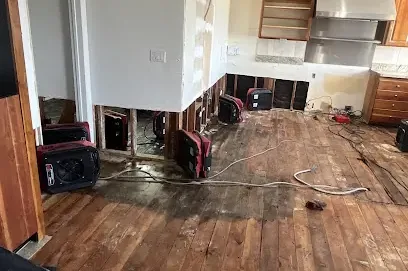
Water pressure in Camas is not one fixed number. The city says pressure runs anywhere from 20 to 150 psi, and that matters because the pipes inside a house take whatever pressure arrives at the meter.
Key takeaways
- City pressure in Camas runs from 20 to 150 psi, a very wide range from one address to the next.
- The city says a reading over 80 psi needs a pressure reducing valve on the house side of the meter.
- The city's responsibility ends at the water meter, so the valve, the pipes and the fittings inside are the owner's.
- A burst pipe under high pressure can move a large amount of water in a short span, so the master valve should be labeled and easy to reach.
- Fast extraction and structural drying limit how far the water spreads into wall cavities and floors.
Why pressure matters more than most owners think
A supply pipe is built to hold water under pressure, but not an unlimited amount of it. Every fitting, solder joint, hose and valve in a house has a limit.
When the pressure sits high for months, small stresses add up. A fitting that would last for decades at moderate pressure can weep, crack or let go at a connection.
The result is often not a drip. A failed supply pipe under strong pressure sprays or pours, and the water finds the wall cavity, the ceiling below or the floor first.
Flexible hoses deserve special attention. Braided hoses on washers, sinks and toilets age from the inside, and the outer braid hides a weak rubber core until the hose bulges or bursts.
- Hose connections at washers and dishwashers take the pressure directly.
- Water heater connections and shutoff valves are common weak points.
- Fittings inside walls are out of sight, so a slow weep can run unnoticed.
What the 20 to 150 psi range means for a household
The city reports that pressure in its system runs from 20 to 150 psi. That is a wide spread, and the number a house sees depends on where it sits on the system.
A home near the low end may never have a pressure problem. A home near the high end carries a steady load on every pipe.
A single reading is only a snapshot. Pressure can shift with the time of day, with demand on the system and with work on the pipes outside, so a gauge check once a season gives a better picture than one check ever.
A reading taken after any plumbing work is worth the effort too. A new valve, a replaced heater or a repaired pipe can change what the rest of the system sees.
Over 80 psi
The city is specific here: pressure above 80 psi needs a pressure reducing valve. The valve sits on the supply pipe near where it enters the house and steps the pressure down for the plumbing inside.
How an owner can find out
A simple gauge screws onto an outside hose bib. It shows the reading at that moment, and a reading that stays well above 80 psi is a reason to have the valve checked.
A reducing valve that has worn out can let full street pressure through without any visible sign.
Who owns what: the meter, the valve and the pipes
The city's responsibility ends at the water meter. Everything from the meter to the house, and the plumbing inside, belongs to the customer.
That includes the master supply valve. The city asks owners to label it, so anyone in the household can shut the water off fast.
The city also says never to turn the city curb stop, which belongs to the system and not to the owner.
A leak after the meter is therefore the owner's to stop. A burst pipe water damage cleanup starts the moment the water is off and the source is found.
- Label the master valve with a tag or paint.
- Keep the area around it clear of boxes and tools.
- Test that it turns fully, since a valve that has not moved in years can stick.
Warning signs that pressure may be too high
High pressure rarely announces itself with a flood. It leaves small clues first, and the clues are easy to explain away.
- Pipes that bang or hum when a faucet or appliance shuts off.
- Faucets that drip even with new washers.
- A toilet that keeps refilling or runs on its own.
- Washing machine or dishwasher hoses that look swollen or sweaty.
- A relief valve on the water heater that drips.
When a pipe lets go under pressure
The first move is the same every time: close the master valve. With the water off, the flow stops and the problem becomes cleanup instead of an active flood.
After that, the order of work matters. Power to wet areas is a hazard, so the breaker for a wet room is switched off if it can be reached safely.
- Shut off the master valve and open a low faucet to drain the pipes.
- Turn off electricity to the wet area if the panel is dry and reachable.
- Move valuables, rugs and small furniture out of the water.
- Take photos for the insurer before anything is removed.
- Call a restoration team so extraction can start before the water spreads.
What the restoration team does next
The first job is extraction. A response team pulls standing water with portable and truck mounted equipment, because every wet hour lets the water wick further into drywall and baseboard.
Water extraction is usually the step that decides how much has to be torn out.
Next comes the moisture map. Meters and thermal imaging show which walls, subfloor and cabinets are wet, including areas that look dry.
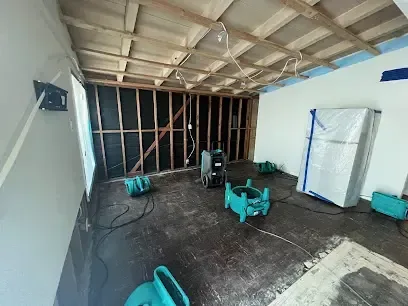
Then structural drying begins. Air movers push dry air across wet surfaces and dehumidifiers pull the moisture out of the room.
Wet drywall that cannot dry in place is cut out so the cavity can breathe.
Drying is checked with readings, not guesses. The equipment stays until the materials read dry, which prevents the damp conditions that let mold start.
Keeping the next burst from happening
Once the damage is dried and the pipe is repaired, the pressure question deserves an answer. A plumber can test the reading and install or replace a reducing valve if the pressure is over the city's 80 psi mark.
A few habits help as well. Replace braided washer hoses on a schedule, test the master valve each season, and know where the meter is.
The water damage cost calculator gives a rough sense of what a burst pipe can run before it is caught.
Insurers often ask whether a pipe failed from wear or from a sudden event. A kept fitting, a dated gauge reading and a plumber's note about the pressure valve make that conversation easier.
A burst pipe that happens once is an accident. A burst pipe that happens twice in the same house points to pressure, and the fix is cheap compared with a second cleanup.
Questions
What is normal water pressure in Camas?
The city says its pressure runs from 20 to 150 psi, so there is no single normal number. The city also says that a reading over 80 psi needs a pressure reducing valve.
Who is responsible for a burst pipe after the meter?
The city's responsibility ends at the water meter. The customer owns the pipes from the meter to the house and the plumbing inside, including the master valve.
Should the city curb stop be used to shut off water?
No. The city says never to turn the curb stop. The master supply valve inside the property is the one owners are asked to label and use.
Does high water pressure always cause a burst pipe?
No, but sustained high pressure stresses fittings, hoses and valves. Signs such as banging pipes and dripping faucets point to a problem worth checking.
What happens to wet drywall after a burst pipe?
Drywall that stays wet and cannot dry in place is cut out so the cavity can be dried with air movers and dehumidifiers. Moisture readings confirm when the wall is dry.