When a pipe bursts, nobody wants to wait for paperwork. Washougal's rule is built for that: emergency repairs can begin first, and the permit follows.
Key takeaways
- Washougal does not require a permit before emergency repairs begin.
- The permit must be applied for on the first business day after the work starts.
- A plumbing permit is not needed to stop or repair a leak in a drain, soil, waste or vent pipe, to clear a stoppage, or to swap a prefabricated fixture without moving pipes or valves.
- Replacing a concealed defective pipe counts as new work and needs a permit and inspection.
- Drying the structure is a separate job from the pipe repair, and it should start while the plumbing is being sorted out.
The rule in plain terms
Washougal Public Works covers water, sewer, stormwater, streets and parks, and the city issues plumbing permits under its own rules. The headline is simple: an emergency repair does not wait for a permit.
The condition is timing. The permit has to be applied for on the first business day after work starts.
A pipe that bursts on a Saturday night is fixed on Saturday night, and the paperwork happens on Monday.
Why cold snaps drive these calls
Washougal averages about 84.2 inches of precipitation a year, and January lows average about 30.5 degrees. Recorded lows have reached 5 degrees in January and 3 degrees in February.
Cold snaps like those are the season when burst pipes cluster. Pipes in unheated spaces split when the temperature falls, and the damage shows when the pipe thaws.
When a plumbing permit is required
The city requires a plumbing permit for plumbing installation, alteration, repair, replacement or remodel. That list is broad on purpose.
In practice, anything that opens a wall to run new pipe, relocates a fixture or replaces a section of supply plumbing sits inside the rule.
- Installing new pipe or a new fixture location.
- Altering the layout of existing plumbing.
- Replacing a section of supply pipe.
- Remodel work that touches plumbing.
Repairs that skip the permit
The city also lists work that does not need a plumbing permit. These are the small, common jobs that follow a leak.
- Stopping or repairing a leak in a drain, soil, waste or vent pipe.
- Clearing a stoppage.
- Swapping a prefabricated fixture without moving pipes or valves.
A useful distinction
A drain stoppage or a leak in a vent pipe is routine maintenance under the rule. A supply pipe that burst inside a wall is a different category, and that is where the next section applies.
The concealed pipe trap
The most important detail for a burst pipe is this one: replacing a concealed defective pipe counts as new work. It needs a permit and an inspection.
A pipe inside a wall or under a floor is concealed. If a section of it failed, the repair is replacement, not patching, and the city treats replacement as new work.
That means the plumber is the one who handles the permit and arranges the inspection. The owner's job is to make sure the work is not closed up before the inspection happens.
A typical case is a supply pipe behind a bathroom wall that splits at a fitting. The wall is opened for drying and the plumber replaces the damaged section.
Because the pipe was concealed and defective, that replacement is new work in the city's eyes.
The same logic applies to a pipe under a floor or above a ceiling. If it could not be seen before the opening, replacing it carries the permit and inspection steps.
Where drying fits in
The pipe repair and the drying are two tracks. Both need to move, and neither should wait on the other.
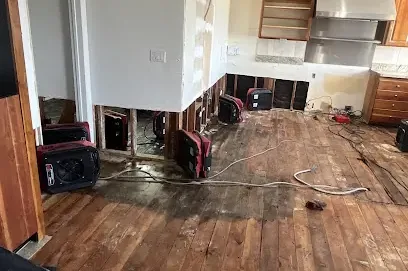
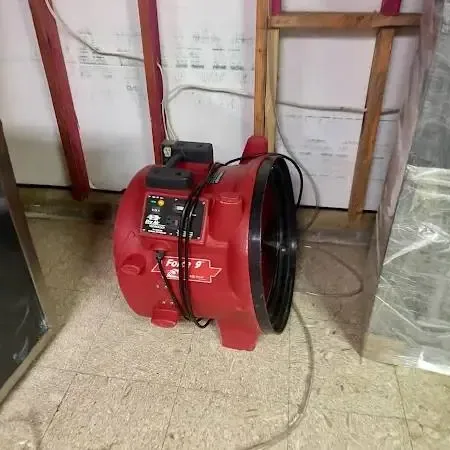
A burst pipe water damage call starts with extraction and a moisture map. The team locates the wet walls and floors and sets up air movers and dehumidifiers.
Drywall around the failure often has to be opened so the plumber can reach the pipe and so the cavity can dry. Opened walls help both jobs.
Water damage does not wait for an inspection date. Wet drywall, insulation and flooring begin to break down while the paperwork moves, which is why the drying team and the plumber share the same open walls.
Coordination helps, and the drying time estimator gives a feel for how long the equipment may stay. The plumber gets a clear view of the pipe, the inspector sees the repair before it is covered, and the drying equipment keeps working in the open cavity.
- Extraction removes standing water first.
- Moisture readings show where the wet materials are.
- Walls are opened at the failed pipe so the plumber can reach it.
- Structural drying runs until readings come back to normal.
A first business day plan
The day after an emergency repair is when the paperwork clock matters. A short checklist keeps the permit and the drying on schedule.
- Confirm with the plumber that the permit application is going in on the first business day.
- Keep every wall opening exposed until the plumber confirms what inspection is needed.
- Send the insurer photos and the date the water was shut off.
- Ask the drying team for the moisture log so it can be shared with an adjuster.
- Do not cover pipe repairs with new drywall until inspection is cleared.
Keeping the paperwork and the evidence
A burst pipe is also an insurance event. Photos of the failed pipe and the wet area, taken before anything is removed, help a claim.
The failed section of pipe is worth keeping if the plumber allows it. An inspector or an insurer may want to see it.
Receipts for emergency work, the permit application date and the inspection date all belong in one folder.
Questions worth asking the plumber
A burst pipe is stressful, and the questions that matter are easy to forget. A written list helps.
- Is this repair a patch, or a replacement of a concealed section?
- Who is applying for the permit, and on what date?
- When is the inspection, and which walls must stay open?
- What is the cause: freezing, age, a fitting or a pressure problem?
- Is the rest of the pipe run in the same condition?
Why the cause matters
A pipe that froze points to insulation and heat. A pipe that wore through points to age or water chemistry.
The cause shapes the repair, and the repair shapes how much of the wall has to stay open for inspection.
Questions
Can a plumber start fixing a burst pipe in Washougal before getting a permit?
Yes. The city does not require a permit before emergency repairs begin, but the permit must be applied for on the first business day after work starts.
Does every plumbing repair need a permit?
No. A leak in a drain, soil, waste or vent pipe, a stoppage, or a prefabricated fixture swap without moving pipes or valves does not need one.
Why does a hidden pipe replacement need an inspection?
The city counts replacement of a concealed defective pipe as new work, so a permit and an inspection are both required.
Who handles the permit?
The plumber doing the work normally applies for it. The city issues the permit, and the owner makes sure inspection happens before the wall is closed.
Should drying wait until the pipe is fixed?
No. Extraction and drying should start right away, and opened walls help the plumber reach the failure.