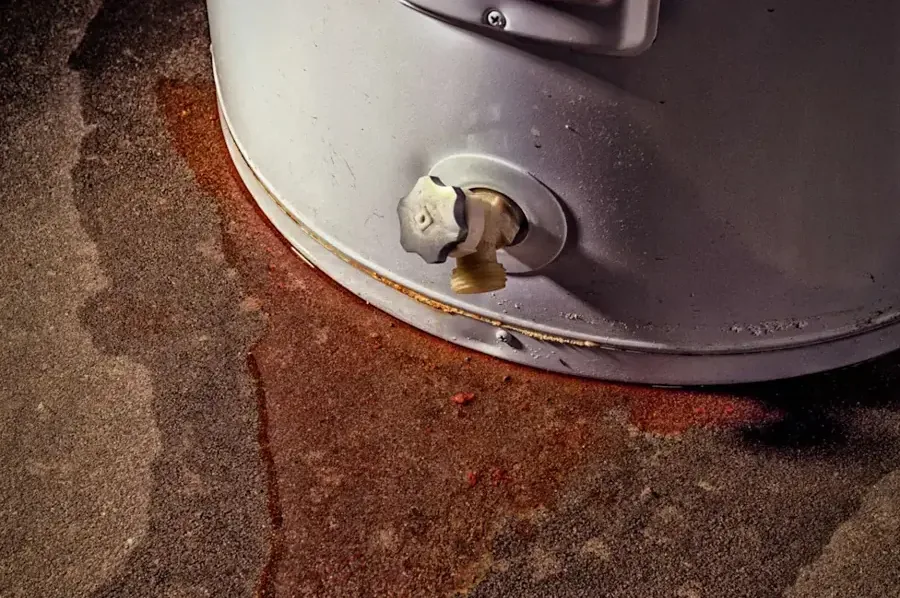
A water heater that leaks can empty a tank onto the floor in a short time. In Gresham, the city offers clear guidance on where the shutoff may be, and that is the first thing to know.
Key takeaways
- The city says the main shut-off valve may be near the water heater, an outside hose bib, the garage, the basement, a crawl space or the meter.
- A homeowner's responsibility for plumbing begins immediately after the meter and continues through the entire home.
- The city Building Division issues building and plumbing permits, and a residential plumbing permit may be issued to a homeowner or a contractor.
- A leaking tank is handled in two parts: stopping the water and drying what it reached.
- Cleanup depends on where the heater sits, since closets, garages and lower levels each hold water differently.
Why a leaking tank is urgent
A tank water heater holds a large volume of water, and the water has to go somewhere when a seam, fitting or valve fails. It spreads across the floor and toward walls, cabinets and any room that sits lower.
Gresham is a city of 114,247 residents in Multnomah County, Oregon, and the city provides water, wastewater and stormwater utilities. Inside the house, though, the plumbing belongs to the homeowner.
Slow leaks matter as well. A tank that weeps at a fitting can leave a rust stain, a soft spot in the floor or a puddle that dries and returns.
Those signs deserve attention before the tank fails outright.
Gresham moved fully to groundwater as its sole drinking water source in spring 2026, a change that ended the supply from the Portland Water Bureau and the Bull Run Reservoir. The new groundwater is harder than Bull Run water, ranging from about 58 to 108 milligrams per liter.
Any tank, old or new, is worth a visual check after a change like that.
Finding the shutoff valve
The city says a homeowner's responsibility for plumbing begins immediately after the meter and continues through the entire home. That includes the main shut-off valve.
The city also says where the valve may be, which is a useful list for anyone who has never looked.
- Near the water heater.
- Near an outside hose bib.
- In the garage.
- In the basement or crawl space.
- Near the water meter.
Find it before the emergency
The valve should be located, tested and labeled now. A valve that has never been turned can stick, and a labeled valve saves precious time when water is running.
Steps when the tank is leaking
Several actions happen in a sensible order. The aim is to stop the supply, remove the energy source and then limit how far the water goes.
A heater that is leaking from the relief valve or its discharge pipe is a different case from one leaking from the tank body. The first can sometimes be fixed.
The second cannot, and the tank is replaced.
The leak should be left alone until the power and supply are off. Touching a wet heater with the power on is a shock hazard.
- Close the cold water supply valve on top of the heater, or the main valve if the heater valve cannot be reached.
- Turn off the power to an electric heater at the breaker, or set a gas heater control to off.
- Keep away from wet outlets and cords.
- Move belongings away from the wet floor.
- Take photos before anything is moved or thrown away.
Where the heater sits changes the cleanup
The city's own list of shutoff locations hints at where heaters live: garages, basements, crawl spaces and utility closets. Each location brings its own water problem.
A garage
Water spreads across the slab and may reach stored belongings and the door to the house. Extraction is quick, but wet cardboard and wood stored on the floor often have to go.
A closet or utility room
Water runs into the baseboard, drywall and flooring of nearby rooms. Wall cavities need moisture checks.
A basement or crawl space
Water can soak insulation, joists and stored items. A larger area often needs pumping before drying can start.
What gets wet and what can be saved
The first things to be affected are the materials closest to the floor. Baseboard, the bottom of drywall, cabinet bases and carpet pad all take in water from below.
Concrete slabs and tile dry well. Carpet and pad, laminate and particle board cabinets do not.
- Likely to dry in place: concrete, tile, solid wood framing, sealed hard surfaces.
- Likely to be removed: wet carpet pad, swollen particle board, insulation that soaked through.
- Case by case: hardwood floors, baseboard, drywall near the floor.
How the cleanup works
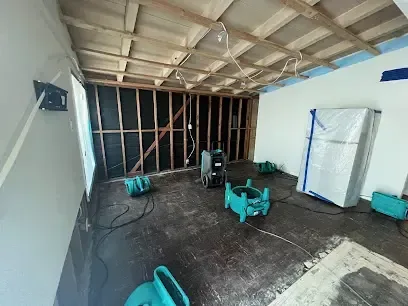
A water heater leak cleanup starts after the water is off. The extraction crew removes standing water, which is the step that decides how far the damage spreads.
After extraction, the team maps moisture in floors and walls. Water extraction is followed by drying with air movers and dehumidifiers.
Wet drywall, baseboard and flooring are removed only if they cannot dry in place. Readings confirm when the area is dry.
Replacement, permits and records
A leaking tank is normally replaced, not repaired. That raises a permit question.
The city Building Division issues building and plumbing permits, and a residential plumbing permit may be issued to a homeowner or a contractor.
Whether a particular replacement needs a permit is a question for that office, and the water damage cost calculator helps size the cleanup. Nothing here assumes the answer, and an owner should ask before work begins.
Records help in the meantime. A photo of the heater label, the date of the leak, the receipts for the replacement and the drying log all support an insurance claim.
A drain pan, a leak sensor and a habit of looking at the base of the tank each season are small steps that catch a slow leak early.
Questions
Where is the main shut-off valve in a Gresham home?
The city says it may be near the water heater, near an outside hose bib, in the garage, in the basement or crawl space, or near the water meter.
Who is responsible for plumbing inside the house?
According to the city, a homeowner's responsibility begins immediately after the meter and continues through the entire home.
Who issues plumbing permits in Gresham?
The city Building Division issues building and plumbing permits, and a residential plumbing permit may be issued to a homeowner or a contractor.
What should be done first when a tank leaks?
Close the supply valve, turn off the power or gas, keep away from wet electrical items and call for extraction.
Does a water heater leak mean the floor has to be torn out?
Not always. Materials that can dry in place are dried, and only soaked materials that cannot be saved are removed.